
A professional esports squad is not five people playing individually; it is a single organism operating through rigid tactical assignments. Understanding diverse esports player roles is essential to grasping how modern teams operate. A player who masters crosshair placement might fail completely if forced to manage team economy, just as an exceptional macro strategist might lack the lightning-fast mechanical reflexes to clear a frontline choke point. To truly comprehend how elite teams function, one must decode the roles and positions that define competitive gaming across the industry’s major genres: MOBA, Tactical FPS, and Battle Royale.
Why Do Esports Roles Demand Extreme Specialization?
The professionalization of esports over the past two decades has driven the margin of error to near zero. A fraction of a second or an unoptimized spell rotation now determines the fate of multi-million-dollar tournaments. This hyper-competitive baseline has made deep positional specialization mandatory for three structural reasons:
- Resource Distribution and Scarcity: Competitive titles feature finite resources within every match—whether gold, experience points, weapons, ammunition, or vision wards. Teams intentionally funnel income into primary damage dealers (“carries”) while tasking low-economy players (“supports”) with maximizing impact using minimal resources.
- Cognitive Bandwidth and Micro-Management: No human brain can simultaneously execute pixel-perfect mechanical inputs, monitor the minimap, track opposing cooldowns, calculate economic status, and devise late-round strategies. Splitting these duties allows each specialist to dedicate 100% of their mental bandwidth to a specific facet of execution.
- Architectural Team Synergy: Professional roster construction is heavily orchestrated behind the scenes by coaching staffs. As detailed in our breakdown of the role of esports coaches and analysts, staff members scout, train, and slot players into distinct systems based on their cognitive profiling, mechanical habits, and emotional temperaments under pressure.
Key Positions in MOBA (League of Legends & Dota 2)
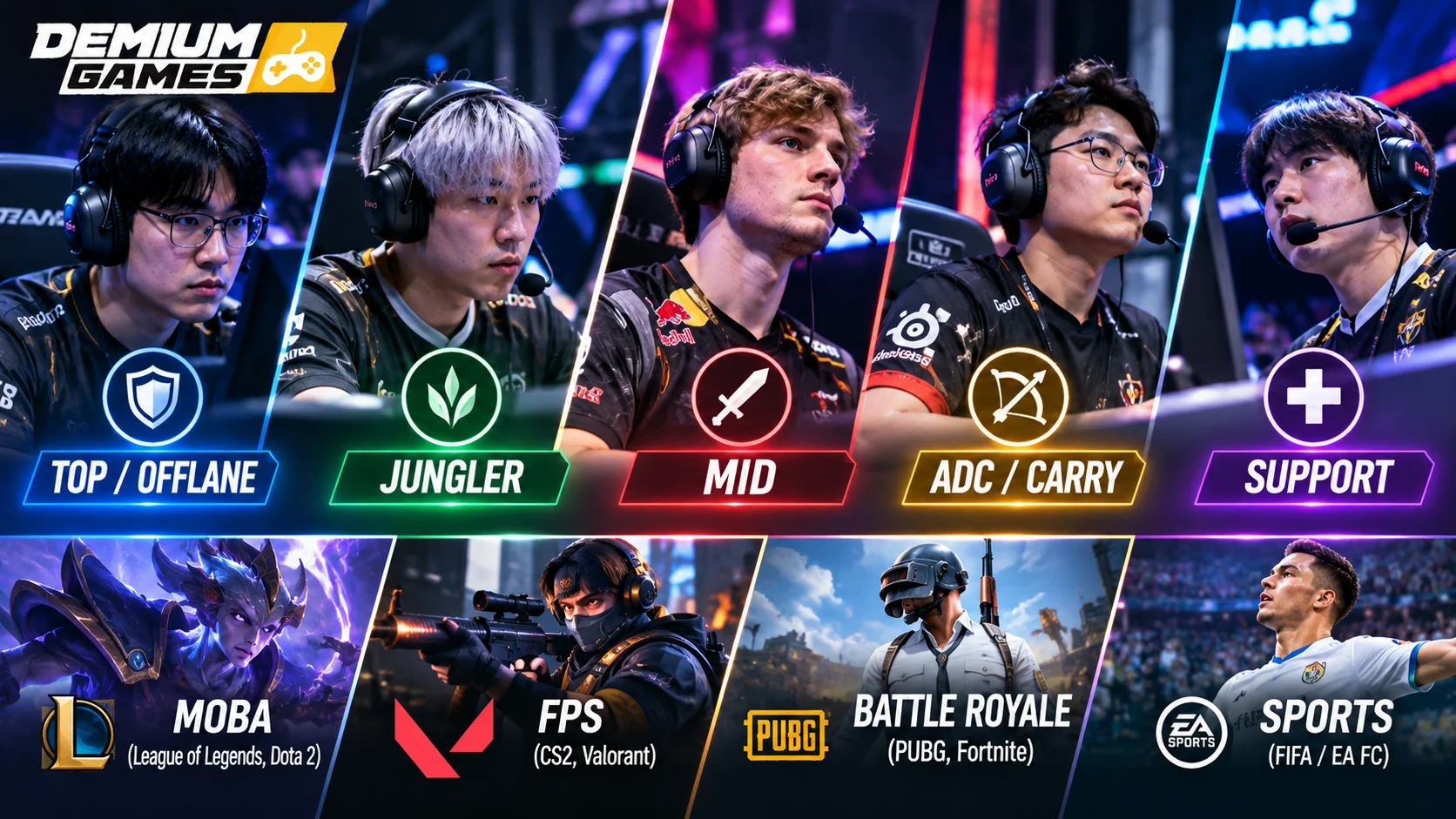
Multiplayer Online Battle Arena (MOBA) titles represent the pinnacle of isometric macro strategy and asymmetric resource management. On standardized maps featuring three lanes, neutral jungle zones, and opposing base structures, teams divide their five players into distinct lanes and functions. This format is the lifeblood of the global League of Legends Esports ecosystem.
1. Top Laner (The Solitary Island & Frontline Pillar)
Positioned in the longest isolated lane, the Top Laner operates in an endurance test of wave management, matchup knowledge, and survivability.
- Primary Function: Absorbing pressure, holding side-lane territory, and creating split-push threats that force opponents to scatter across the map.
- Champion Archetypes: Bruisers (Darius, Fiora, Renekton) or Super Tanks (Ornn, Sion, Malphite). In Dota 2, this closely aligns with the “Offlaner” (Position 3), whose job is to disrupt the enemy carry’s early safety.
- Key Skill: Flawless wave freeze mechanics, telecommunication timing, and knowing how to stay relevant even when receiving zero jungle support.
2. Jungler (The Tempo Dictator & Map Engine)
The Jungler does not belong to a lane; instead, they harvest neutral monster camps cloaked in the fog of war. They are the unseen puppet masters of the early match.
- Primary Function: Controlling early map pace, staging ambush attacks (“ganks”) to give laners an advantage, and securing pivotal neutral objectives such as Dragons, Rift Heralds, and Barons.
- Champion Archetypes: High-mobility assassins (Lee Sin, Elise) or team-fighting disruptors (Sejuani, Jarvan IV).
- Key Skill: Pathing efficiency, predictive game sense to track the invisible enemy counterpart, and psychological timing under extreme smite/punish pressure.
3. Mid Laner (The Mechanical Core & Central Pivot)
The Mid Laner commands the shortest, most volatile, and most strategic lane on the map. Because the lane sits directly in the center, a strong Mid Laner can exert instant pressure toward either side of the map.
- Primary Function: Establishing lane priority, roaming to support skirmishes in the river, and serving as a massive source of burst magic or physical damage in mid-to-late teamfights.
- Champion Archetypes: Control Mages (Orianna, Syndra, Azir) and High-Burst Assassins (LeBlanc, Zed, Akali).
- Key Skill: Rapid mechanical execution, lightning-fast wave-clearing discipline, and split-second spatial awareness during cross-map roams.
4. ADC / Bot Lane Carry (The Glass Cannon & Insurance Policy)
The Attack Damage Carry (ADC), also known as the Bot Laner (or Position 1 Safe Laner in Dota 2), is the team’s sustained damage dealer. They start the match fragile and vulnerable, requiring steady protection, but scale into unstoppable damage engines once equipped with core items.
- Primary Function: Providing consistent, uninterrupted ranged damage in 5v5 teamfights and rapidly taking down enemy structures and neutral bosses.
- Champion Archetypes: Marksmen (Jinx, Kai’Sa, Aphelios, Ezreal).
- Key Skill: Pixel-perfect positioning behind allied tanks, extreme threat assessment, and stutter-stepping (orb-walking) while under attack.
5. Support (The Playmaker & Vision Architect)
The Support spends the early game protecting the ADC, but their responsibilities quickly expand across the entire map. Operating with the least amount of gold, a great Support dictates the outcome of a match purely through map control and crowd control.
- Primary Function: Establishing vision control through deep ward placement, sweeping enemy vision, peeling for carries, and initiating decisive teamfights.
- Champion Archetypes: Enchanters (Lulu, Nami), Engage Tanks (Nautilus, Leona, Thresh), or aggressive roaming lane dominators.
- Key Skill: Low-economy utility maximization, impeccable map awareness, sacrificial play, and communication coordination.
Core Roles in Tactical FPS (CS2 & Valorant)
In tactical round-based first-person shooters like those featured in professional Counter-Strike 2 Esports, players do not pick fixed fantasy classes; instead, roles are defined by weaponry, economy, spawn positioning, and tactical execution duties. Tactical breakdowns found across Red Bull Esports Gaming Guides consistently show how defined FPS responsibilities prevent structural chaos during split-second site executions.
1. In-Game Leader (IGL)
The IGL is the general on the battlefield. While executing their personal mechanics, they carry the cognitive burden of reading the enemy’s defensive setup and calling tactical adjustments on the fly.
- Key Responsibilities: Reading opposing defensive tendencies, tracking enemy bank accounts, calling mid-round rotations, and keeping team composure intact during losing streaks.
- Distinguishing Trait: Strategic genius and decisive verbal communication, often accepting lower personal frag counts in exchange for systemic round wins.
2. Entry Fragger
The Entry Fragger is the team’s battering ram. Whenever an attacking side decides to take a bomb site or push through a dangerous smoke choke point, the Entry Fragger goes in first.
- Key Responsibilities: Peeking into hazardous crossfire angles, clearing standard defensive hiding spots, securing the opening kill, or dying in a position where an immediate trade kill can be secured by a teammate.
- Distinguishing Trait: Fearless aggression, pinpoint crosshair placement upon corner checking, and zero hesitation when crossing utility thresholds.
3. The Sniper / AWPer
Armed with the most expensive and lethal weapon on the board (the AWP in CS2 or the Operator in Valorant), the Sniper serves as an economic anchor and space-denying powerhouse.
- Key Responsibilities: Holding down long corridors, securing instantaneous opening picks on careless rotations, and shutting down enemy fast-pushes with single-shot eliminations.
- Distinguishing Trait: High-risk precision, instinctual reaction speeds under 180ms, and exceptional movement mechanics to escape after firing a shot.
4. Support / Utility Specialist
In CS2, this role handles flashbang setups, smoke deployments, and bomb plants. In Valorant, this is typically the Initiator or Controller agent (such as Sova, Fade, Omen, or Viper).
- Key Responsibilities: Blinding defensive anchors so entry fraggers can advance safely, smoking off sightlines, deploying reconnaissance arrows/drones, and safely securing bomb plants/defusals.
- Distinguishing Trait: Encyclopedic lineup knowledge, spatial geometry mastery, and pristine trade-frag discipline.
5. Lurker
While the core squad executes toward a specific site, the Lurker operates completely isolated on the opposite side of the map, creeping in silence.
- Key Responsibilities: Cutting off enemy rotations through the map’s center, gathering audio intel on defensive retreats, and back-stabbing the opposing team when they scramble to respond.
- Distinguishing Trait: Elite trigger discipline, unpredictable movement patterns, and psychological mastery of when to reveal presence.
Squad Roles in Battle Royale (PUBG, Apex Legends, Warzone)
Battle Royale competitions inject unique chaos: 16 to 20 teams drop onto a massive map simultaneously with randomized loot spawns and contracting boundary circles. In this survival matrix, esports player roles adapt to high-stakes improvisation:
1. The Caller / IGL (Zone Navigator)
Survival in Battle Royale depends heavily on circle predictions and positioning. The Caller dictates when to fight, when to disengage, and which compound to claim. They must choose between early-rotation strategies (securing god-spots inside the ring early) or edge-of-zone clearing (killing late teams moving into the circle).
2. The Scout / Recon Specialist
Operating slightly ahead of the main squad, the Scout monitors vacant buildings, tracks enemy vehicle traffic, and interacts with survey beacons. In games like Apex Legends, scouts typically pilot high-mobility characters (Pathfinder, Valkyrie) that can gather crucial intelligence and escape without dying.
3. The Fragger / Anchor
The muscle of the squad. When two teams collide inside a building or behind a rock formation, the Fragger spearheads the close-range skirmish. The Anchor, on the other hand, watches the team’s rear flanks to prevent third-party ambushes from opportunistic teams closing in on gunshot audio.
Summary: The Power of Defined Execution
In modern competitive gaming, raw individual talent merely opens the door; structured role execution wins championships. Understanding different esports player roles—whether an unselfish Support creating vision, an Entry Fragger sacrificing their life for map territory, or an IGL crafting mid-round rotations—completely changes how one views competitive matches.
As the global esports industry continues its rapid evolution, positions will become even more specialized. Players who embrace the discipline of a dedicated role—subordinating personal glory to collective execution—are the ones who ultimately lift championship trophies on the international stage.