
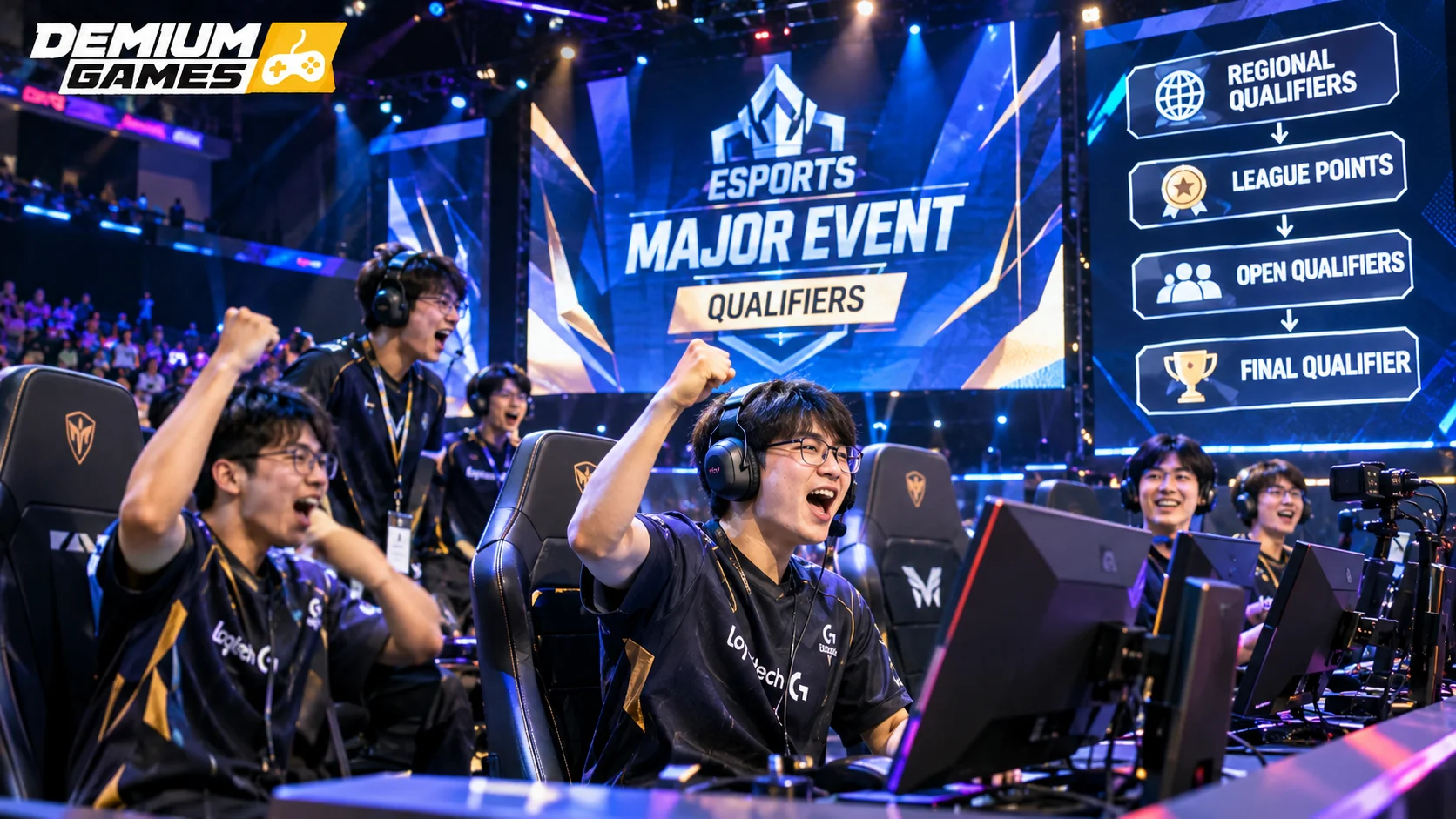
Qualifying for a premier event is rarely a simple invitation process; it is a cutthroat gauntlet featuring regional barriers, mathematical ranking algorithms, open brackets, and high-stakes playoff stages. Understanding how these pathways operate—and how they integrate with diverse esports tournament formats—reveals why simply surviving the qualification gauntlet is an extraordinary achievement in its own right.
How Esports Teams Earn Spots at Major Tournaments
At its core, the modern esports qualification framework balances two competing priorities: meritocratic fairness and financial stability. Tournament organizers and game publishers want the absolute best teams competing on the main stage to guarantee peak athletic quality. At the same time, commercial stakeholders, sponsors, and franchised organizations demand predictable exposure and continuous visibility for their multi-million-dollar investments.
To resolve this tension, international championships allocate berths using geographic distribution. Instead of hosting a single worldwide tournament, developers partition the globe into competitive zones—typically the Americas, EMEA (Europe, Middle East, and Africa), APAC (Asia-Pacific), and China. Each region is allotted a set number of qualification slots based on historic international performance, player base size, and regional infrastructure. Teams must then navigate a multi-layered filtering hierarchy, progressing from grassroots local qualifiers up through regional showdowns before finally punching their tickets to the global main event.
Open Qualifiers vs. Closed Qualifiers
The preliminary rounds of almost every major esports tournament are divided into two distinct competitive phases: Open Qualifiers and Closed Qualifiers. This dual-stage pipeline allows unexpected amateur squads to test their mettle against seasoned veterans while protecting the integrity of the tournament from early randomness.
Open Qualifiers: The Democratic Meat Grinder
Open qualifiers represent the democratic heartbeat of competitive gaming. In theory, any five eligible players with an internet connection, a registered game account, and a dream can sign up to compete. There are no franchise fees or celebrity requirements. If you win your matches, you advance.
- Format and Pacing: Open brackets regularly feature hundreds—sometimes thousands—of amateur and semi-professional teams competing in single-elimination, Best-of-One (Bo1) brackets over a single weekend.
- The Cinderella Factor: Open qualifiers produce esports’ most electrifying underdog stories, where unranked collegiate or pub-star stacks upset well-funded organizations on live streams.
- Inherent Risks: Because matches are played online in high-speed Bo1 formats, open qualifiers are notoriously volatile. Fluke strategies, unexpected server latency, and bracket exhaustion can occasionally eliminate top-tier teams prematurely.
Closed Qualifiers: The Gatekeeper Stage
Teams that successfully survive the open qualifier gauntlet are rewarded with an invitation to the Closed Qualifier (sometimes labeled the Regional Qualifier). Here, open bracket survivors collide with established professional teams that received automatic seeding based on previous season results or domestic standing.
- Format and Integrity: Closed qualifiers ditch chaotic Bo1 brackets in favor of structured formats such as double-elimination brackets or round-robin groups featuring Best-of-Three (Bo3) matches. This dramatically reduces randomness and ensures that tactical depth, map pool flexibility, and preparation dictate the winners.
- Controlled Environments: Closed qualifiers frequently feature dedicated referee oversight, mandatory anti-cheat software inspections, and dedicated communication servers to guarantee competitive integrity. The top finishers from this stage directly secure their tickets to the Major event.
Direct Invites and Circuit Points Systems
Not every world-class roster has to fight through the mud of online open qualifiers. To reward sustained excellence, tournament organizers utilize direct invites and year-long circuit point architectures.
Direct Invites and Global World Rankings
Direct invitations are granted to the reigning elite of the competitive scene. In open-circuit ecosystems, teams earn direct seeds to playoffs or group stages based on official global leaderboards. Valve Corporation, for example, utilizes the Valve Regional Standings (VRS) to determine direct invitations to Regional Major Rankings (RMR) events, as detailed in our comprehensive breakdown of how CS2 Majors explained operates. Similarly, independent circuit operators establish clear mathematical matrices where match wins, prize money won, and the relative strength of defeated opponents govern invitations; this transparent methodology is codified directly in the ESL Pro Tour Qualification Rulebook to prevent subjective bias.
Circuit Points: Rewarding Year-Long Consistency
To prevent “one-hit wonders” from stealing slots based on a single weekend of good fortune, many tier-1 circuits use Championship Points. In this model, points are awarded based on final placements across seasonal splits (Spring, Summer) and mid-season international tournaments.
By tallying performance metrics across the entire competitive calendar, circuit point models ensure that only the most consistent, adaptable teams represent their home regions at year-end world championships. It tests a team’s longevity across shifting balance patches, meta evolutions, and roster adjustments.
Franchised Leagues vs. Promotion and Relegation Systems
The structural philosophy governing qualification changes dramatically depending on whether an esport operates under a closed franchised framework or an open promotion/relegation architecture.
Franchised Leagues: The Closed Corporate Ecosystem
In franchised leagues—such as Riot Games’ League of Legends regional circuits (LCK, LPL, LEC, LCS) and the Overwatch League historically—esports organizations purchase permanent league slots for tens of millions of dollars. There is no relegation.
- Qualification Mechanism: Because external teams cannot play their way into the domestic league from outside, qualifying for international Majors is strictly internal. The franchised organizations battle through regular seasons and domestic playoffs. The top two, three, or four playoff finalists earn the regional seeds to international events like the Mid-Season Invitational (MSI) and the World Championship.
- Commercial Upside: Franchising provides stable employment for athletes, predictable broadcast schedules for fans, and long-term security for corporate sponsors willing to sign multi-year deals.
The Hybrid Model: Ascension and Promotion
To avoid closing the door completely on grassroots talent, modern titles have pioneered hybrid structures. A prime example is the international circuit of the Valorant Champions Tour (VCT). In this ecosystem, permanent partner teams anchor the International Leagues (Americas, EMEA, Pacific, and CN), while semi-pro tier-2 rosters battle through regional Challengers leagues for a chance to win the annual Ascension tournament. Winning Ascension grants a temporary, multi-year promotion into the top tier, allowing non-franchised underdog rosters to earn their way into Masters and Champions events through pure merit.
Conclusion: The Grueling Road to the Stage
The complete esports qualification journey is an endurance marathon that tests every facet of an organization. From surviving grueling single-elimination open brackets alongside thousands of hopefuls to maintaining mathematical consistency across grueling seasonal splits, every team appearing on a Major stage has run a gauntlet of immense pressure. The next time you watch a team walk out into a roaring stadium, remember: their battle did not begin on that stage—it began months prior in the ruthless, unseen arenas of the qualification circuits.