
Contents: What Are Esports Prize Pools? | Where Does Esports Prize Money Come From? | How Are Esports Prize Pools Distributed? | Examples of Esports Tournament Prize Pools | How Much Prize Money Do Esports Players Keep? | Prize Money vs Esports Player Salaries | FAQs About Esports Prize Pools
What Are Esports Prize Pools?
An esports prize pool is the designated financial reserve allocated to compensate teams and individual players who compete in a video game tournament. When organizers announce an upcoming championship, the total prize pool represents the overall cumulative sum distributed across all eligible placements, rather than a single prize taken home by the eventual champion.
In the broader ecosystem covered on our gaming and esports platform, prize pools serve dual roles: they incentivize top-tier competitive performance and act as promotional anchors for spectators, corporate sponsors, and media outlets. A tournament boasting a record-breaking financial purse commands attention across social channels and sports media, elevating the status of both the players and the game itself.
The calculation and announcement of a prize pool generally follow one of two models:
- Fixed-Cap Prize Pools: The tournament operator or publisher sets a static, guaranteed amount before the competition begins (e.g., $1,000,000 or $500,000). This figure remains constant regardless of ticket sales, in-game purchases, or viewership levels.
- Dynamic (Crowdfunded) Prize Pools: Organizers provide a baseline seed amount, which increases over a promotional window through a percentage of in-game purchases, digital battle passes, or spectator contributions. The final figure is calculated and announced shortly before or during the championship event.
Where Does Esports Prize Money Come From?
Esports tournaments rely on distinct revenue channels to gather, guarantee, and pay out competitive rewards. While traditional professional sports generate major portions of their prize reserves from broadcast rights contracts, competitive gaming draws capital from game publishers, corporate partners, and grassroots player communities.
Publishers & Organizers
Video game publishers (such as Valve, Riot Games, Epic Games, and Krafton) treat competitive circuits as customer engagement and retention instruments. When a developer provides the prize purse directly from its marketing budget, the payout serves as a player acquisition expense. A vibrant competitive ecosystem keeps millions of daily active users playing, discussing, and watching the game, indirectly bolstering microtransaction revenue.
Independent tournament organizers—including ESL FACEIT Group and BLAST—often collaborate with national governing bodies or private investment groups to fund circuit purses. In national-team competitions, non-profit federations pool municipal hosting rights fees and regional development budgets to assemble prize offerings across various esports titles.
Sponsors & Commercial Partnerships
Corporate brand integrations are a vital lifeline for third-party tournaments. Brand support falls into two main profiles:
- Endemic Sponsors: Manufacturers of computer hardware, gaming monitors, mechanical keyboards, mice, and gaming chairs. These companies sponsor tournament rewards in exchange for product placement, on-stage hardware usage, and direct sales exposure to dedicated PC and console users.
- Non-Endemic Sponsors: Multinational brands outside the gaming sector, such as beverage manufacturers, financial institutions, automotive firms, and telecommunications carriers. These brands provide straight cash injections to access the coveted Gen-Z and millennial demographics who are less reachable through traditional television advertising.
Community Crowdfunding
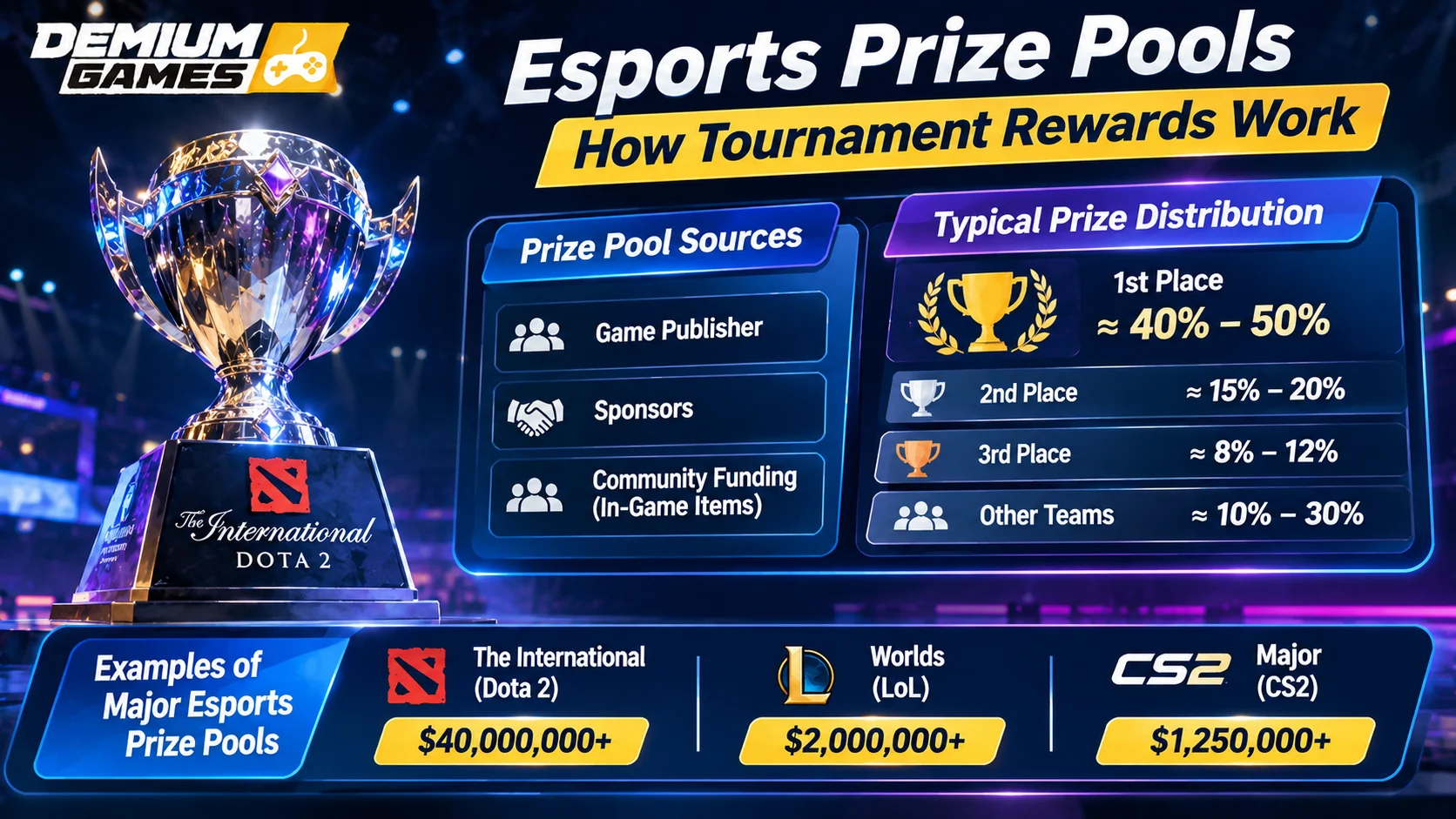
Crowdfunding has generated some of the largest payouts in gaming history. Under this operational model, the publisher designs exclusive digital assets—such as event-themed character skins, team stickers, weapon camos, or virtual interactive compendiums—and pledges a set percentage (commonly 25%) of all generated sales directly to the tournament’s prize purse.
This method bridges player engagement directly with the professional tier. Fans purchase in-game cosmetic goods to enhance their own gaming experience while knowing their financial contributions directly support the players and teams competing on the world stage.
How Are Esports Prize Pools Distributed?
Announcing a multi-million dollar purse does not mean the champion walks away with the entire sum. How that capital is apportioned across the field is dictated by structural distribution matrices that mirror the tournament’s overall competitive design.
Placement-Based Payouts
Organizers build tiered payout scales before an event begins, defining exact percentages for each ranking. A typical distribution model allocates the largest cut to the champion, with decreasing shares cascading down through the rankings:
- 1st Place (Champions): Typically receives between 30% and 50% of the total pool.
- 2nd Place (Runners-up): Commonly awarded 15% to 20%.
- 3rd and 4th Place: Frequently receive between 7% and 10% each.
- Lower Bracket & Group Stage Finishers: Awarded smaller, flat percentages designed to cover travel overhead, lodging, and minor competitive rewards.
The specific distribution matrix is tied to the competition’s progression framework. Organizers align these payout thresholds with their bracket style, whether running Swiss systems, double elimination brackets, or round-robin stages. Readers looking for a breakdown of these bracket rules can explore our comprehensive analysis of esports tournament formats to understand how seeding and progression affect placement.
Team vs. Player Awards
Tournament rewards differentiate between collective team performance and individual mechanical achievement:
- Main Event Placements: The overwhelming majority of the prize pool is awarded collectively to the team organization or roster entity based on overall placement.
- Ancillary & MVP Bonuses: Some tournaments allocate separate discretionary pots for performance accolades. These include Most Valuable Player (MVP) awards, “Rookie of the Tournament” honors, or community-voted highlight plays. MVP prizes are often awarded directly to the individual athlete rather than the club.
Examples of Esports Tournament Prize Pools
To examine how prize money operates in practice, it is crucial to analyze verified tournament data. The table below outlines prominent international events across various genres, contrasting overall prize pools against the specific payouts granted to the first-place finishers.
| Tournament | Game | Year | Total Prize Pool | Winner’s Share | Source |
|---|---|---|---|---|---|
| The International 10 | Dota 2 | 2021 | $40,018,400 | $18,208,300 (45.5%) | Valve Seed ($1.6M) + In-Game Battle Pass Sales |
| Fortnite World Cup Finals | Fortnite (Solo) | 2019 | $15,287,500 | $3,000,000 (19.6%) | Epic Games (Direct Marketing Allocation) |
| Esports World Cup (Club Championship) | Multi-Title (22 Events) | 2024 | $60,000,000+ | $7,000,000 (Top Club Share) | Esports World Cup Foundation (Direct Funding) |
| 18th World Esports Championship (WEC26) | Multi-Title (7 Events) | 2026 | $500,000 | Distributed Across 7 Disciplines | IESF & Host Venue Allocation |
Data across these tournaments demonstrates distinct commercial strategies. Valve’s 2021 Dota 2 championship harnessed massive community microtransactions to yield the largest single-tournament pool in esports history, where first place secured over $18.2 million. In contrast, the multi-title model exemplified by the 2026 World Esports Championship in Banten, Indonesia distributes a confirmed $500,000 total reserve across seven separate competitive categories (including Counter-Strike 2, Mobile Legends: Bang Bang, and PUBG Mobile). As confirmed in the official IESF – WEC26 Prize Pool Announcement, this structure spreads rewards across more than 160 national teams rather than concentrating the capital entirely into a single winner-take-all payout.
How Much Prize Money Do Esports Players Keep?
A common misconception among casual fans is that professional players personally pocket every dollar listed on a giant tournament check. In reality, the net amount that lands in a competitor’s private bank account is significantly reduced by several contractual, administrative, and legal deductions.
Team Contracts and Organizational Splits
Professional competitors do not always receive the entire sum awarded to their team. Instead, the division of tournament winnings is dictated by the specific terms laid out in each athlete’s legal employment contract with their esports organization. These splits vary considerably depending on the organization’s business model, the player’s market value, and the region in which they operate:
- Player-First Agreements: Some organizations allow players to retain 100% of their tournament winnings, utilizing the prize pool purely as an internal performance incentive while sustaining company operations through commercial sponsorships and digital apparel sales.
- Shared Revenue Agreements: Other clubs operate on an organizational cut model, retaining an agreed percentage of prize earnings to offset travel overhead, training facilities, bootcamps, and administrative support staff.
- Coaching and Support Allocations: Roster agreements frequently assign a portion of the team prize share to non-playing personnel, such as head coaches, tactical analysts, and substitute players who helped the team prepare for the competition.
Because these terms are governed by confidential bilateral contracts between organizations and players, there is no universal industry-wide percentage. Speculating on exact percentages without verified, publicly disclosed player agreements is unreliable.
Taxes and Mandatory Withholdings
Prize earnings are classified as taxable income in almost every legal jurisdiction. When a team wins prize money in a foreign country, the local government frequently applies foreign withholding tax at the source—often ranging between 20% and 30%—before the remaining funds are wired out of the host country. Upon receiving the funds domestically, athletes and clubs must declare the remaining payout, subjecting it to local municipal and federal income taxes.
Prize Money vs Esports Player Salaries
To evaluate the financial stability of professional gamers, one must distinguish variable tournament winnings from guaranteed income streams. As detailed throughout our esports news and analysis, modern esports earnings have evolved far beyond the tournament-or-bust model of early LAN competitions.
- Guaranteed Base Salaries: Professional players signed to franchised leagues or top-tier organizations receive fixed monthly or bi-weekly salaries. These payments are legally guaranteed regardless of competitive outcomes, providing financial security against tournament slumps.
- Tournament Prize Pools: Prize money functions primarily as a performance bonus. While a lucrative tournament run can dramatically increase an athlete’s annual earnings, it remains an irregular, unpredictable revenue source.
- Sponsorships and Endorsements: Elite competitors negotiate personal endorsement deals with apparel, hardware, and lifestyle brands. These agreements supply guaranteed retainer fees alongside performance clauses for content creation.
- Streaming and Content Creation: Many professionals generate recurring baseline income via live-streaming platforms, ad monetization, subscription splits, and digital viewer donations during off-season periods.
While winning a premier tournament offers career-defining milestones, long-term athletic sustainability depends on balanced base compensation rather than relying exclusively on volatile prize distributions.
FAQs About Esports Prize Pools
What is the biggest esports prize pool?
The largest single-tournament prize pool in esports history was Dota 2’s The International 10 (2021), which reached a total of $40,018,400. The prize pool was driven by a baseline seed from Valve combined with community purchases of the in-game Battle Pass.
Do esports teams split prize money?
Yes. Prize money earned by a roster is split among active starting players and is often shared with head coaches, strategic analysts, and reserves. Furthermore, the parent organization may retain a contractual cut depending on the terms agreed upon in the players’ professional contracts.
Is esports prize money taxable?
Yes. Esports tournament rewards are treated as taxable income. Winning teams are typically subjected to withholding taxes in the country where the tournament takes place, along with domestic personal income and corporate taxes when the funds return to their home jurisdiction.
Do esports players earn salaries?
Yes. Top-tier and franchised professional esports athletes receive contractual base salaries paid by their organizations. Prize money serves as a variable performance incentive layered on top of this guaranteed baseline pay.
Who funds esports tournaments?
Tournament funding originates from a combination of game publishers (from marketing budgets), commercial sponsors (endemic hardware vendors and non-endemic brands), tournament organizers, media broadcasters, and community crowdfunding via in-game item purchases.