
In this complete guide to esports rankings explained, we break down how mathematical point decay operates, compare developer circuits with third-party trackers, and reveal how to interpret professional leaderboards across Counter-Strike 2, League of Legends, and VALORANT.
Contents: What Are Esports Rankings? | How Are Esports Rankings Calculated? | Official vs Independent Esports Rankings | How Rankings Work in Different Esports Games | Why Do Esports Team Rankings Change? | How to Read Esports Rankings Correctly | Frequently Asked Questions
What Are Esports Rankings?
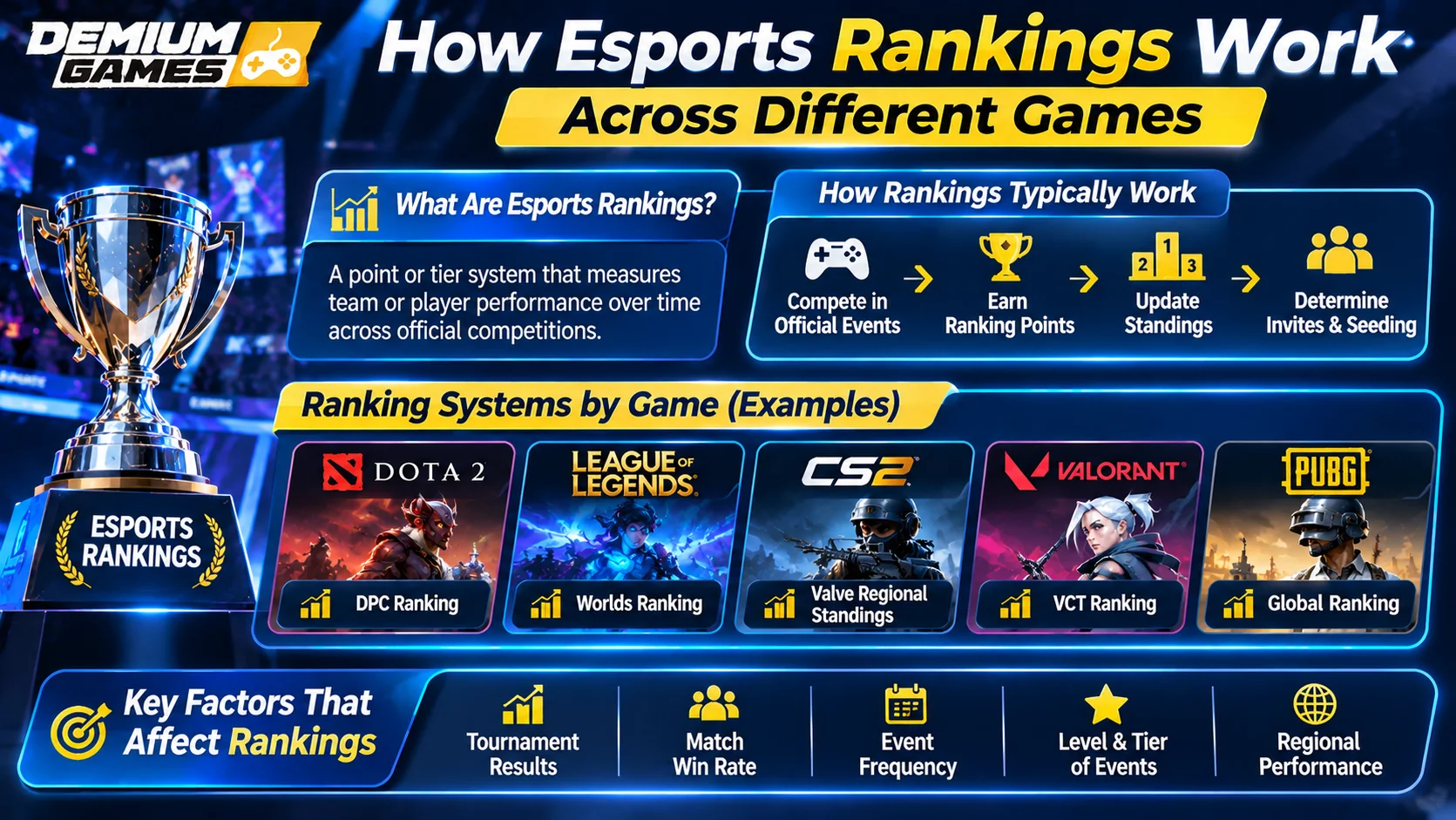
An esports ranking is an empirical or point-based hierarchy designed to assess, order, and compare the competitive capability of teams or individual athletes within a professional gaming ecosystem. In the early days of competitive gaming covered across our gaming portal, measuring which team reigned supreme was largely subjective, determined by community forum arguments and local LAN dominance. As the stakes evolved into multi-million-dollar leagues, the industry required formalized, transparent methods to categorize relative team strength.
Today, professional esports rankings fulfill several operational functions beyond fan curiosity:
- Direct Tournament Invitations: Major tournament organizers bypass grueling open qualifiers by extending direct invites to top-ranked rosters.
- Bracket Seeding: Accurate rankings prevent top contenders from colliding in the opening rounds of an event, ensuring competitive fairness across playoff brackets.
- Commercial Valuation: Esports clubs use their position on recognized leaderboards to negotiate corporate sponsorships, jersey placements, and venture capital funding.
- Broadcast Storytelling: Casters, analysts, and production desks rely on historical ladder positions to frame rivalries, upset narratives, and underdog stories during live broadcasts.
How Are Esports Rankings Calculated?
While each gaming title utilizes proprietary mathematical formulas, modern ranking engines rely on a consistent set of competitive variables. Understanding how these metrics interact helps demystify sudden leaps or drops on the global leaderboard.
Tournament Results and Placements
The foundational component of any ranking system is raw match output. However, not all victories are weighted equally. Advanced algorithms evaluate the prestige and difficulty of the competition where results occur:
- Tier Weighting: Winning a LAN championship against world-class opposition yields exponentially more points than winning an online weekly cup against regional amateur teams.
- Series Formats: Victories secured in Best-of-3 (Bo3) or Best-of-5 (Bo5) series carry heavier statistical weight than Best-of-1 (Bo1) matches, which inherently feature higher volatility and tactical randomness.
- Deep Bracket Finishes: Consistent second- and third-place finishes across elite international tournaments frequently reward more cumulative ranking points than winning a single lower-tier tournament followed by early group exits.
Opponent Strength and Quality of Wins
Modern esports ranking systems rarely award flat points for match wins. Instead, they incorporate modified Elo or Glicko algorithms that calculate the relative difficulty of an opponent. Under this framework, beating the #1 team in the world earns an underdog a massive injection of ranking points, whereas the #1 team defeating a squad ranked #80 yields negligible points because that victory was statistically expected.
Furthermore, systems assess map differentials and round dominance. A clean 2-0 sweep against an elite opponent demonstrates greater command than a narrow 2-1 overtime victory, influencing how many points the winning and losing sides exchange.
Ranking Points, Roster Continuity, and Decay
Competitive gaming moves quickly, with balance patches, meta shifts, and player fatigue altering team dynamics month to month. To keep leaderboards reflective of current performance, systems deploy two essential mechanisms:
- Point Decay: Points earned in previous months slowly lose their value over time. A championship won ten months ago might only retain 10% of its initial point weight, eventually expiring altogether after a designated evaluation window (typically 6 to 12 months).
- Roster Continuity Rules: Points adhere to players, not corporate logos. Under common regulatory standards, if a team replaces more than two players on a five-man roster (breaking the “three-man core”), the organization forfeits a significant percentage of its historical points, preventing new rosters from coasting on the past achievements of departed athletes.
Official vs Independent Esports Rankings
The competitive gaming landscape is divided into two distinct ranking categories: publisher-managed systems and community-run media leaderboards. Each serves a fundamentally different purpose within the ecosystem.
Official rankings are engineered directly by game developers to govern tournament access. The most notable example is the Valve Regional Standings (VRS), which Valve established to determine direct invitations to Counter-Strike 2 Major Championships and their associated closed qualifiers. Because open qualifiers were eliminated in several regions to streamline the ecosystem, the VRS serves as the ultimate arbiter of which teams qualify for the world’s most prestigious CS2 events.
Conversely, independent rankings—such as the weekly HLTV World Ranking or community power ranking portals—function as journalistic assessments of form. While these media rankings do not officially grant tournament slots under publisher bylaws, their rigorous mathematical modeling makes them the gold standard for global spectator debate.
A critical point of confusion for casual fans is distinguishing official developer releases from third-party invite trackers. For instance, media outlets maintain real-time simulation models based on the HLTV – Valve Ranking for Majors. While HLTV runs a predictive model tracking live match outcomes to project who will earn invitations, Valve releases its official VRS leaderboard only at specific, periodic snapshot dates. A team may appear to hold an invite position on an external tracking model, but until Valve publishes its verified official calculation at the contractual snapshot deadline, those positions remain projections rather than official qualifications.
How Rankings Work in Different Esports Games
Because structural designs vary across competitive titles, each primary esport executes its ranking logic differently.
Counter-Strike 2 (CS2)
Counter-Strike 2 operates on an open-circuit philosophy overseen by Valve’s regulatory mandates. Teams earn spots at tier-one tournaments via their Valve Regional Standings, which calculate prize money won, strength of opposition defeated, and head-to-head records. Concurrently, the HLTV World Ranking updates every Monday, tracking a 1,000-point scale broken into three sub-categories: past achievements (past year), recent form (past two months), and individual LAN performance ratings.
League of Legends (LoL)
Riot Games takes a closed, franchised league approach with League of Legends. Rather than a singular, unified global ladder, regional circuits (such as South Korea’s LCK, China’s LPL, or Europe’s LEC) maintain seasonal standings. To decide which teams advance to international showcases, Riot employs a seasonal Championship Points system, awarding points based on Spring and Summer Split playoff performances. You can read our detailed analysis of these regional splits in our dedicated esports news and analysis hub.
VALORANT
VALORANT merges franchise leagues with a seasonal points framework. Through the VALORANT Champions Tour (VCT), teams collect VCT Championship Points across Kickoff tournaments, international Masters events, and regular-season stages. Consistent performance across the year directly dictates qualification for VALORANT Champions, making every stage match impactful toward season-ending prestige. How these points dictate international seeds is detailed further in our overview of esports qualification pathways.
Comparison of Major Esports Ranking Systems
The table below summarizes the operational differences, regulatory bodies, and evaluation criteria across the industry’s most prominent competitive ranking frameworks.
| Ranking System | Game | Operator | Main Criteria | Update Frequency |
|---|---|---|---|---|
| Valve Regional Standings (VRS) | Counter-Strike 2 | Valve Corporation | Prize money won, opponent win-rate, LAN head-to-heads | Periodic official snapshots |
| HLTV World Ranking | Counter-Strike 2 | HLTV.org | Tournament trophies (12 mos), recent form (2 mos), LAN statistics | Weekly (Every Monday) |
| VCT Championship Points | VALORANT | Riot Games | Regular season match wins, Masters placements, Kickoff finishes | Post-match / Stage conclusion |
| LoL Championship Points | League of Legends | Riot Games | Playoff finishes across regional Spring and Summer Splits | End of Split / Playoff cycles |
| ESL World Ranking | Multi-Title (CS2, SC2) | ESL FACEIT Group | Placements at ESL Pro Tour and partnered global events | Weekly / Post-event cycles |
Why Do Esports Team Rankings Change?
Fans frequently notice teams climbing or falling on a leaderboard even when they have not played a match recently. Several factors trigger these fluctuations:
1. Point Expiration and Decay Windows
When an older tournament result drops out of an algorithm’s evaluation window (for instance, surpassing the 12-month mark), all points associated with that championship vanish from the team’s total. If a rival organization maintains a more balanced, recent distribution of points, they will naturally overtake the inactive roster.
2. Roster Adjustments and Benchings
Player transfers alter ranking math dramatically. In titles like CS2, moving a starting player to the bench causes the team to forfeit that individual’s contribution to their ranking points. If an organization replaces two or three players at once, their team rating drops sharply, reflecting that the newly constructed lineup has yet to prove itself as a cohesive competitive unit.
3. Relative Opponent Shifts
Because mathematical ranking models evaluate the quality of a team’s beaten opponents, a team’s points can fluctuate based on the subsequent success of teams they played weeks prior. If Opponent A goes on an international winning streak, the historic win your team secured over them becomes statistically more impressive, retroactively boosting your ranking coefficients.
How to Read Esports Rankings Correctly
To avoid misinterpreting leaderboard data during competitive seasons, keep the following principles in mind:
- Check the Evaluation Methodology: Distinguish between purely algorithmic systems (like VRS or Elo) and editorial power rankings. Algorithmic rankings reward cold mathematical outcomes; editorial power rankings reflect analyst assessments of current momentum, tactical innovation, and player form.
- Inspect Roster Flags: Look for indicators showing whether a roster is currently playing with a substitute or an incomplete five-man lineup. A lower ranking often reflects missing personnel rather than a decline in mechanical skill.
- Identify LAN vs. Online Variance: Top-tier rankings prioritize offline (LAN) results inside stage arenas over online regional qualifiers. A team dominating online leagues may rank lower than a squad that performs well under the pressure of live stage environments.
Frequently Asked Questions
How often do esports rankings update?
Update schedules depend on the operator. Media rankings like HLTV update weekly every Monday. In contrast, developer-run qualification systems—such as Valve’s VRS or Riot’s Championship Points—update following the conclusion of specific competitive stages or at scheduled regulatory snapshot deadlines.
Can an esports team lose ranking points without playing?
Yes. Teams lose points passively due to decay algorithms. As historical tournament victories age, their weighted contribution diminishes, allowing active teams with recent match results to surpass inactive squads on the leaderboard.
What is the difference between Valve Regional Standings and the HLTV Ranking?
Valve Regional Standings (VRS) is an official publisher system used specifically to issue invitations to CS2 Major Championships and closed qualifiers. The HLTV World Ranking is an independent media-driven leaderboard designed to measure ongoing form and historical achievement for community and analytical purposes.
Do all esports use the same ranking system?
No. Open-circuit games like Counter-Strike 2 rely on dynamic global point systems and publisher-mandated ladders. Franchised, closed ecosystems like League of Legends and VALORANT use localized seasonal standings and Championship Points tied directly to developer-owned leagues.
Why do roster changes cause teams to drop in rankings?
Most ranking frameworks attach points to the individual players rather than the corporate organization. When a player leaves a team, their earned points leave with them, preventing an organization from retaining an elite seed after replacing core talent.